
A checkpoint for AI actions
Your AI is about to act on something it read. TruVector checks it first.
TruVector sits between an AI system and the action it’s about to take. It checks where the information came from, whether the sources are really separate, and whether they agree. Then it answers: go ahead (Allow), have a person look (Review), or stop (Block). Every answer comes with its reasons, so someone can check it later.
The problem
AI systems now act on information nobody checked.
Most systems still stop at generating text. The new risk is action: answers to customers, approvals, orders, filings, published posts.
The risk isn’t only that an AI says something wrong. It’s that it acts on something wrong, and afterward nobody can tell what it was relying on.
Most AI systems now answer by retrieving material first: search results, documents, a vendor feed, a database row. Then they act on what came back.
Most AI tools work on producing better answers. TruVector works on the step after the answer: it combines what several models read, how separate the sources are, and a plain decision rule, in a record a person can check.
TruVector is built for that gap. It doesn’t write content, it doesn’t declare what’s true for the world, and it doesn’t trust a source just because it’s a big name.
What it checks
Three questions before every action.
- Where did this come from? Every piece of information the AI is relying on is traced back to its source, with when and where it appeared.
- Are these really separate sources? Fifty pages repeating one wire story are one source, not fifty. Known shared origins receive diminishing effective weight under the selected dependence parameter. The formula is in WP-02; it is the cluster-sampling design effect, not a reputation score.
- Do the sources agree? When sources conflict, the conflict stays visible in the answer instead of being averaged away.
The answer is Allow, Review or Block, evaluated under the stated support, quorum, subject, and action-reading conditions. It is a recorded check on the material behind one action, not a verdict on whether the statement is true for the world.
Readers interpret meaning. Arithmetic evaluates the decision.
Structured support, refutation, and uncertainty are combined with source weights. Embeddings guard subject relevance; separate readings assess instruction consistency. The reported 60-statement comparison produced 58 correct decisions versus 14 for the earlier gate under the original labels. This preliminary statement-only study is documented with its scope in the research papers.
The arithmetic
Move the numbers yourself.
This is how text becomes numbers and numbers become a decision. Four steps, then the three places inside an autonomous system where the arithmetic runs. Steps 01 to 04 each work a formula from the Lane Vector working papers; 05 to 07 show that arithmetic at work inside a system that acts. Drag a control and the result follows.
01Reading
Mapping Words to Coordinates
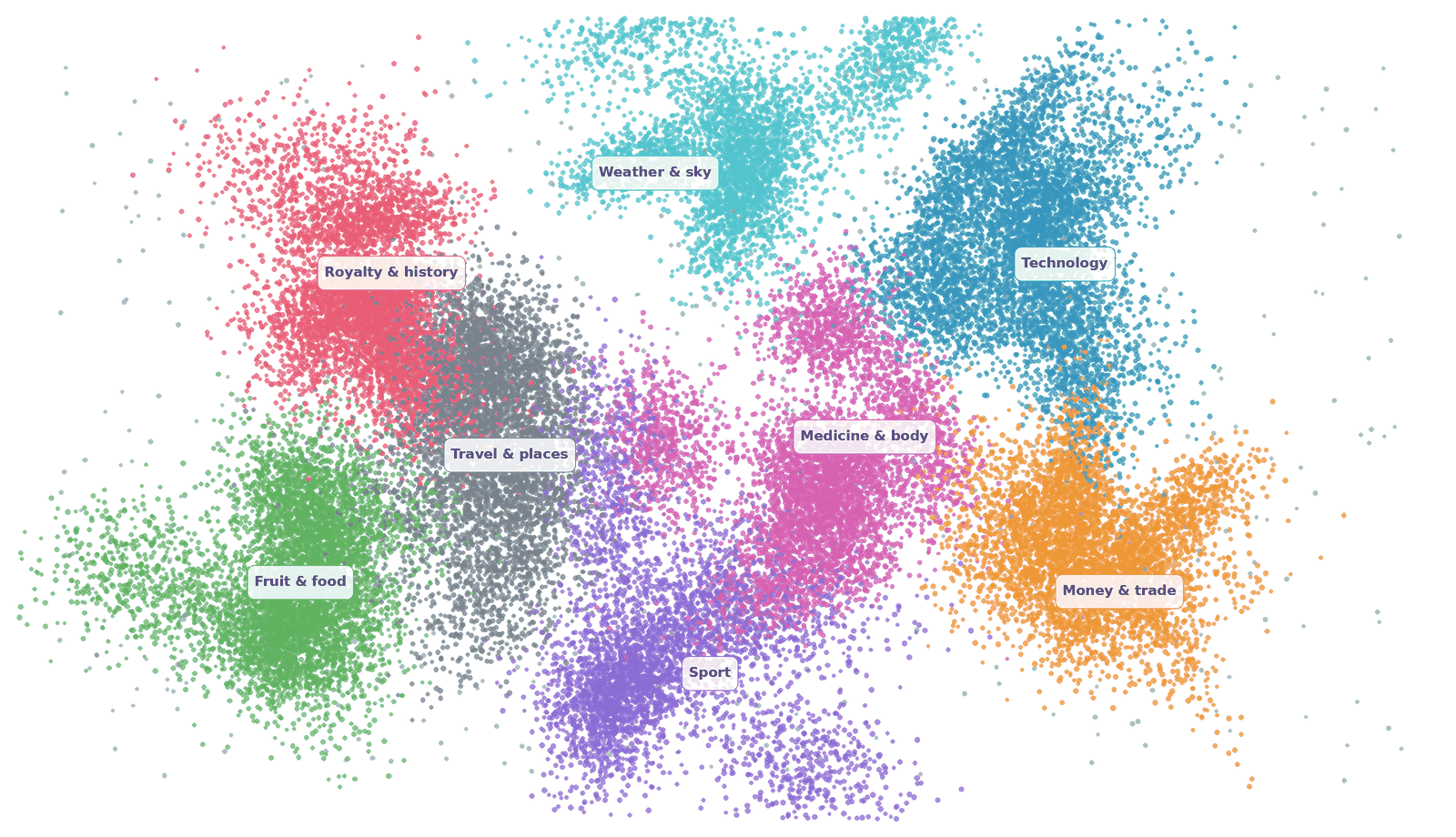
A computer cannot do math on words. So every word, sentence or paragraph is turned into a list of numbers: a coordinate in a space with hundreds of dimensions. Two of those dimensions are drawn here. Meaning becomes distance. Words that mean similar things land close together, and a whole sentence becomes one arrow to one point.
At the starting sentence, “The queen addressed the court from the throne,” the whole sentence becomes one point and lands beside king, queen and throne. The positions on this map are schematic: they show how an embedding arranges meaning, not the numbers of one named model.
text → x ∈ ℝᵈ An embedding model turns text into d numbers, usually 384 to 1,536 of them. Two are drawn here. Which model and which basis must be stated before any angle means anything. WP-01 §2.
02Direction
Vector Cosine Similarity
Once text is an arrow, two arrows can be compared by the angle between them. cos θ runs from 1, the same direction, through 0, unrelated, to −1, the opposite direction. Volume says how much text there is; the angle says how much of it points at the question. One limit to keep in mind: between two pieces of text, this angle only says whether they are about the same subject. Whether one supports or refutes the other comes from a reading, not from the angle.
At the starting angle of 60° and a volume of 10,000, cos θ is 0.50, so 5,000 of the 10,000 counts toward the question. A plain count would report all of it.
cos θ = (A · B) / (‖A‖ ‖B‖) and the expected contribution is V ‖w‖ cos θ with ‖w‖ = 1. Exact when the outcome is a straight-line function of the signal. WP-01 §2.
03Counting
Astroturf Detector Simulation
An AI agent searches a topic and finds 500 accounts all saying the same thing. Each dot is one account, and it looks like a crowd of ordinary people. Switch on Astroturf Mode to see the same crowd when it is fake: 500 accounts that look separate but are run by 5 operators. λ is how alike the accounts run by one operator are, estimated from three things: how alike the wording is, how synchronized the timing is, and how much the accounts’ networks overlap.
A real crowd of 500 people who each speak for themselves counts as 500 sources. In Astroturf Mode at the starting coordination level of 0.50, the same 500 accounts run by 5 operators count as about 9.9 sources, and adding more fake accounts would not help: each operator tops out at 2.0.
n_eff = m / (1 + λ(m − 1)) worked out for each origin, then added up. λ is a declared illustration parameter here and is estimated in a study. A correctly identified group approaches 1/λ for positive λ. WP-02 §3.
04Timing
Acceleration Signal Test
Is a story really speeding up, or is that just noise? Acceleration is the change in the change of a count, and the noise in that estimate is known before any data arrives. Check too often and the noise drowns the answer. Check less often and the estimate settles onto the true line.
At the starting settings (checking every 2 samples, noise of 20 per check, a true acceleration of 2) the noise in the estimate is about 12.2 and the signal-to-noise ratio about 0.16: below 1, so the estimate is mostly noise. Widen the interval and it settles onto the true line.
sd(a) = √6 · σ / h² for independent noise. Correlated noise requires covariance-aware propagation; interval-dependent covariance can change the scaling. WP-01 §3.
Where it goes inside an autonomous system.
An AI agent reads, agrees, and acts. Each is a place the same arithmetic runs before the next step is taken. These three panels are analytical illustrations; the research directions below say what would prove each one wrong.
05Input
TruVector RAG Firewall
Most AI assistants search before they answer. An attacker who plants fifty copies of one article can make a search look like fifty sources agreeing. Here the results pass through the arithmetic from step 03 before the AI reads them. Raise the number of planted copies, then switch the filter off to see what reaches the AI without it.
At the starting settings, 50 separate sites and 50 planted copies arrive. With the filter on, the 50 copies count as about 1.1 sources, and 98% of what the AI reads comes from separate sites. With it off, the copies count as 50 and half of what the AI reads is the attacker’s.
n_eff = m / (1 + λ(m − 1)) with λ = 0.95 for the planted set, because copies of one article are nearly identical. WP-02 §3.
06Process
TruVector Consensus Protection
Agents working together settle questions by agreeing. If an attacker copies one compromised agent ninety times, a vote goes 90 to 10 and the system does the wrong thing with confidence. This panel is a simulation of the origin discount from step 03 applied to an agent group: counting origins instead of votes changes the result. Whether one λ is enough when agents share inputs several levels deep is an open direction, stated below with the result that would disprove it. Switch the arithmetic off to see the plain vote.
At the starting settings, 10 honest agents face 90 clones of one compromised agent. A plain vote goes 90 to 10 and the clones win. Counted by origin, the 90 clones count as about 1.1, because they are one origin repeated, and the honest view holds, 10 to 1.1.
n_eff = m / (1 + λ(m − 1)) with the illustrative λ = 0.9 for the repeated origin. WP-02 §3.
07Action
Output Alignment
Before an agent acts, the instruction it was given and the action it proposes are both turned into coordinates, and the angle between them says whether the action is still about what was asked. An action that has wandered onto another subject shows up as an angle before it shows up as a consequence. The angle cannot tell “do it” from “do not do it”; that is a separate reading by the models, after this check. Turn the action away from the instruction and watch the decision change.
At the starting settings the action has turned 15° from the instruction and cos θ is 0.97, above the bar of 0.70, so the action is still about what was asked and goes on to the reading that checks it does what was asked. Below the bar, a person looks at it first. The angle never gives permission on its own.
cos θ = (a · w) / (‖a‖ ‖w‖) with w the instruction and a the proposed action, both as coordinates from step 01, in a declared basis. This is the decision engine’s own use of the angle, not a result from the working papers: the angle checks the subject of the action, and whether the action carries the instruction out is read separately.
The reading step, before and after.
The research path from here: the models read, the arithmetic judges. Reader labels carry support and refutation. Embedding comparisons guard subject relevance. Source weights and thresholds determine the aggregation policy. Counting stays outside the readers, where its inputs, weights, and thresholds can be inspected, and the decision stays a formula a person can recompute by hand.
08Judging
Meaning, Not Words
Several models read the same statement and each says what it means to it: supports, refutes or unsure, and how sure. Then something has to turn those readings into one decision. The working prototype does it by counting words: how many words the replies share, and how often nine words like “however” and “false” appear. The replacement never counts words. The models do the reading; the arithmetic counts origins, measures direction and certainty, and decides. Pick a case and compare the two side by side.
Three readers support the statement in different words, and one of them writes “but”. The word count sees little shared wording and a marker word, scores 0.00 and blocks it. The meaning-based decision sees three origins supporting with certainty 1.00 and allows it. With three copies of one reply the word count scores a perfect 1.00 and allows; the meaning-based decision counts one origin repeated and holds it for a person.
D = S − R, C = 1 − H(S, R, U) with S, R, U the readers’ shares weighted by confidence and by origin, D = S − R the direction, and C the certainty (how concentrated the readings are on one answer). This panel isolates stance aggregation under assumed passing guards and quorum. Complete decisions additionally require the subject, unsupported-reader, and action checks in WP-02. C is not calibrated correctness probability.
Where the research has to go next.
Each direction is stated with the result that would prove it wrong. The first three are about measuring meaning, the crucial parameter; the rest are about counting it.
- Which model assigns the coordinates, and what the angle can carry Every number in step 01 depends on the model that assigned it, so the model is named and pinned in every record. Across five embedding models the angle separated “same subject” from “unrelated” perfectly and put a sentence within a hair of its own negation; so the angle guards subject and the readers’ stances carry direction. It would be disproved as a fixed division of labour if a model’s angle separates “same point” from “opposite point” as well as a reader does.
- Calibrating a reader’s confidence A reader that says 0.9 should be right about nine times in ten. For each reader, how often a stated 0.9, 0.7 and 0.5 is right is measured on a labelled set, and a correction fitted on half is tested on the other half. It would be disproved if the correction does no better than the raw confidence on the half it never saw; then alternative confidence policies are compared with label-only weights.
- λ between readers How alike are ten runs of one model, one model under two prompts, and two models from different makers? The within-family correlation sets the discount in step 08. It would be disproved as a grouping if runs inside one model family are no more alike than runs across families; then common dependence and alternative grouping policies are evaluated.
- Measuring λ for each kind of material λ for syndicated news is not λ for scraped product pages or for text written by a model. It would be disproved as a stable quantity if the value measured on one half of a collection falls outside the interval measured on the other half.
- Finding the origins Copying more is capped at 1/λ. Making one origin look like several is not. It would be disproved if planted copies from a single controlled origin ever lift the count above that cap.
- Agents that agree with each other Copies of one model, one prompt or one retrieval run share an origin too, and sharing can be nested several levels deep. It would be disproved if a discount with a level for each kind of sharing does no better than a single λ on agent groups whose shared inputs are known.
- Direction against a plain count Whether weighting material by its angle to the question predicts the outcome better than volume alone. It would be disproved if the weighting adds nothing on material held back from fitting.
- Acceleration as an earlier warning Whether a story that is speeding up can be flagged sooner than a volume threshold flags it. It would be disproved if the lead time disappears once both are held to the same false-alarm rate.
- Fitting the bars once the readings are right Today’s bars were fitted to word counts. The allow and block bars in step 08 are refitted on a labelled set, half for fitting and half held back. It would be disproved as a rule if the bars chosen on one half mislabel more of the other half than a plain majority of readers does.
- The angle between an instruction and an action Coordinates put a sentence close to its own negation, so the angle in step 07 can say whether an action is about what was asked, not whether it does what was asked; that is read separately. It would be disproved as a useful guard if actions on another subject slip past the bar as often as actions on the right one.
A crowd is cheap to manufacture. Independence is not. That is the difference TruVector measures before an AI reads, before it agrees, and before it acts.
Boundaries
Three things TruVector is not.
- Not a chatbot or content writer It produces no content of its own. It checks the information other systems are about to act on.
- Not a fact-checking service It doesn’t rule on whether a statement is true. It measures how well the information behind an action holds up, and shows where sources conflict.
- Not a truth machine It tells you whether the information behind one specific action is solid enough for what that action costs, with its uncertainty stated.
Company
Built by an engineer who measured things for a living.
Built by Michael Brandon Lane.
InTellMe is an independent research and software company founded and operated by Michael Brandon Lane, a chemical engineer and chemist based in Johnson City, Tennessee.
Before InTellMe, Lane worked at Celgard on lithium-ion battery separator and coating technology, including the development and scale-up of coated separator systems for high-volume manufacturing. He is a named inventor on multiple Celgard patents covering coated battery separators, including U.S. Patent 11,949,124.
That work shaped how he builds software: every number should trace back to a measurement, uncertainty should be stated out loud, and conclusions should change when the data does.
Lane Vector applies an engineering discipline of defined variables, uncertainty, and controlled comparisons to signal direction, temporal change, and source dependence. TruVector combines reader interpretation with those calculations before an AI action.
Company: InTellMe · The science: Lane Vector
Contact
Talk to the person who built it.
Technical questions, research correspondence and partnership conversations all reach the same inbox, and the reply comes from the engineer.